POLITICAL ECONOMY • April 3, 2026
This is the second in a three-part series. Part 1 examined the democratic foundations of FC Barcelona. This instalment traces the club's sporting peak in 2009, its first commercial compromises, and the financial collapse of the Bartomeu era.
By the 2008–09 season, FC Barcelona had arrived at what many observers would later identify as the high-water mark of the club's modern history. Under their first full season with Pep Guardiola, the team was dismantling opponents with a consistency and aesthetic clarity that the sport had rarely seen, a style of play that would soon be given a name the entire football world would recognise: tiki-taka.
The philosophy was not new. Its roots ran back through Johan Cruyff's revolutionary tenure as manager in the late 1980s, through the La Masia academy that had been quietly producing technically refined players for three decades, and through a Catalan football culture that had always prized intelligence and movement over physicality. What Guardiola did was distil all of that inheritance into its most concentrated form. His Barcelona pressed as a unit when out of possession, suffocating opponents high up the pitch. In possession, they moved the ball with a speed and precision that made structured defensive systems look helpless, not because of individual brilliance alone, but because the collective was always a step ahead of what any defence could anticipate.
The numbers from that season speak to the dominance. Barcelona scored 105 goals in La Liga alone, conceding just 35. In the Champions League, they struck 18 goals in the group stage before dismantling Olympique Lyonnais (6–3 on aggregate), annihilating Bayern Munich 4–0 in the first leg of the quarter-finals at Camp Nou, and then surviving a brutal semi-final against Chelsea, decided only by Andrés Iniesta's extraordinary goal in the final seconds of the second leg.
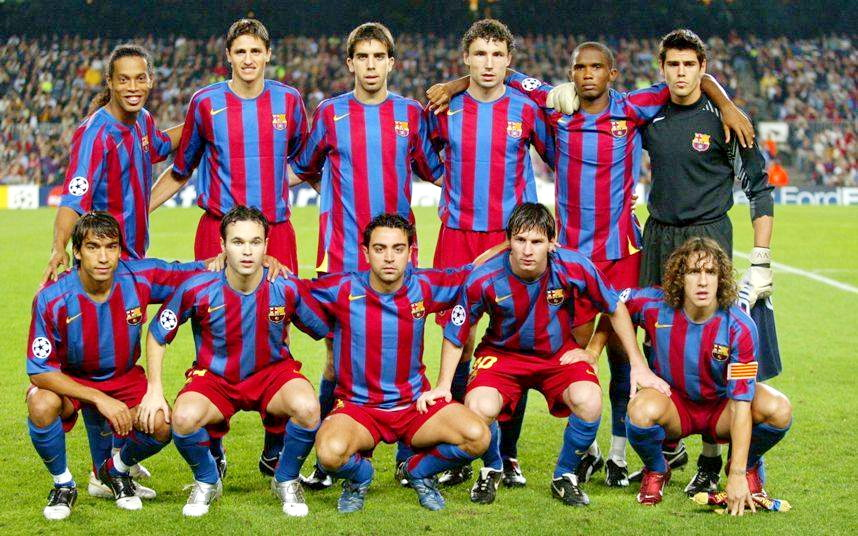
The climax came on May 27, 2009, at the Stadio Olimpico in Rome. The Champions League final against Manchester United, the reigning European champions and one of the most powerful clubs in the world at the time, should have been a contest. It was not. Barcelona were imperious. Samuel Eto'o opened the scoring in the 10th minute, and Lionel Messi headed in the second from a Xavi cross on the 70th minute to seal a 2–0 victory and complete the first treble in Spanish football history, La Liga, Copa del Rey, and Champions League, all in a single season.
The Rome final was not merely a sporting achievement. It was the culmination of an institutional philosophy: a playing squad built almost entirely through an academy, coached by a man who had himself come through that same system, playing football that expressed values (collective intelligence, technical excellence, relentless pressing) that reflected the club's identity. It was the moment when the La Masia project and the Més que un club ethos felt most completely realised on a football pitch.
That coherence between institution and performance, however, would prove difficult to sustain. The commercial pressures that followed would test whether the model that produced the 2009 generation could survive the decade ahead.
The Sporting Peak: Guardiola's System and the 2008–2012 Generation
Pep Guardiola was appointed first-team manager in June 2008. He had been a Barça player and Barça captain, and his tactical vision was a direct extension of the Johan Cruyff philosophy that had shaped La Masia for three decades. His system demanded extreme positional discipline, relentless pressing, and a fluid 4–3–3 formation that could morph in possession into a 3–4–3 or a 2–3–5.
The squad he inherited was built almost entirely on academy graduates. Xavi Hernández, Andrés Iniesta, Víctor Valdés, Sergio Busquets, Pedro, Carles Puyol, all products of La Masia. Lionel Messi himself, though born in Rosario, Argentina, had arrived at La Masia at the age of 13 in 2000, when the club agreed to fund his growth hormone treatment, and was as much a product of the academy as any player who grew up in Catalonia.
Between 2008 and 2012, this team won an extraordinary sequence of trophies:
- 3 La Liga titles (2009, 2010, 2011)
- 2 UEFA Champions League trophies (2009, 2011)
- 2 Copa del Rey titles (2009, 2012)
- 2 FIFA Club World Cups (2009, 2011)
The 2009 team established a tactical grammar that influenced a generation of coaches globally, from the Spanish national team's 2010 World Cup triumph to Guardiola's subsequent work at Bayern Munich and Manchester City. Journalist Martí Perarnau, who chronicled Guardiola's methods closely in his book Pep Confidential, argued that what Guardiola built at Barcelona was living proof that a patient, philosophy-driven approach to football, built through an academy over decades, could consistently defeat the world's best.
The Blank Jersey: 107 Years of Commercial Restraint
To understand the significance of what came next, it is worth pausing on what Barcelona had been for the previous century. From the club's founding in 1899 until 2006, for 107 years, FC Barcelona had operated without a commercial shirt sponsor. The blue and claret (blaugrana) stripes were considered institutionally "sacred", a visual marker of the club's identity as a member-owned institution that did not exist to generate returns for an external corporation.
This was not merely symbolic. It was financially significant. The club was, in effect, sacrificing tens of millions of euros per season in potential sponsorship revenue, a luxury that was only possible because the socio model provided stable membership income and the La Masia production line kept transfer spending modest. By the time Guardiola's team were winning the treble in 2009, the UNICEF logo had already been on the shirt for three seasons, the first break in that 107-year tradition, and one that, as the next section explains, was only the beginning.
The Humanitarian Pivot: UNICEF (2006) and the First Compromise
The first departure from the blank jersey occurred in 2006 under President Joan Laporta. Laporta's innovation was to frame the move not as commercialisation but as its opposite. Barcelona agreed to wear the UNICEF logo on their shirts, but instead of receiving money from UNICEF, the club paid UNICEF, pledging to donate a minimum of €1.5 million annually (later raised to €2 million) to support global child welfare projects.
The move was politically brilliant. Traditionalists who might have objected to a corporate logo could not easily object to the United Nations Children's Fund. Critics who might have accused the board of selling out could not accuse them of profiting. The club positioned itself as "the club for the children of the world," reinforcing the Més que un club ethos in a new, globally legible way.
But there was a longer-term institutional consequence that commentators only recognised in retrospect: the UNICEF deal broke the psychological taboo of a logo appearing on the shirt. It prepared the socios (gradually, gently) for what was coming next.
The Commercial Slippery Slope: Qatar Foundation and Qatar Airways (2010–2017)
By 2010, the financial landscape of European football had shifted dramatically. The English Premier League's television rights deals were generating revenues that La Liga clubs could not match. The emergence of state-backed clubs, most critically, Manchester City (acquired by Abu Dhabi interests in 2008) and Paris Saint-Germain (acquired by Qatar Sports Investments in 2011), created a new category of competitor unconstrained by the economics of self-sustaining clubs.
Under President Sandro Rosell, Barcelona signed a landmark deal in December 2010 with the Qatar Foundation, a non-profit organisation aligned with the Qatari government. The deal, worth €30 million per season, made the Qatar Foundation logo the first paid commercial sponsor to appear on a Barcelona shirt, ending a 111-year tradition of commercial abstinence.
The institutional debate was fierce. Critics pointed to Qatar's human rights record and the conditions facing migrant workers in the country. Rosell's counter-argument, widely reported at the time, was pragmatic: he acknowledged his personal preference for a blank shirt, but maintained that the club could not sustain its competitive position without the income, and that staying financially competitive was itself a form of protecting the institution.
By 2013, the non-profit Qatar Foundation had been replaced on the shirt by the purely commercial Qatar Airways, further eroding the moral framing of the original deal. Despite sustained criticism, the majority of the socios' delegate assembly ratified both transitions, prioritising financial competitiveness over historical tradition.
The commercial trajectory was now established. The blank jersey was gone. The humanitarian justification was fading.
The Bartomeu Era: A Study in Institutional Failure (2014–2020)
The presidency of Josep Maria Bartomeu, who assumed office in January 2014, represents the most damaging period in the club's recent institutional history. On the pitch, the early years were spectacular: the club won the treble in 2015 (La Liga, Copa del Rey, and Champions League) under manager Luis Enrique, with a forward line of Messi, Neymar Jr., and Luis Suárez that generated 122 goals across all competitions that season.
Off the pitch, however, the financial governance was deteriorating toward catastrophe.
The Neymar Effect and Panic Spending
When Neymar Jr. departed to Paris Saint-Germain in August 2017 for a world-record fee of €222 million, it created a structural crisis in the club's transfer logic. Rather than accepting that PSG had simply paid an unsustainable price, the Barcelona board responded by attempting to replace him with a series of high-profile, high-cost acquisitions, none of which justified their fees.
| Player |
Transfer Fee |
Outcome |
| Philippe Coutinho |
€160 million |
Underperformed; eventually sold at a substantial loss |
| Ousmane Dembélé |
€148 million |
Repeatedly injured; bonuses easily triggered |
| Antoine Griezmann |
€120 million |
Poor cultural fit; sold back at a significant loss |
| Lionel Messi (2017 Contract) |
€555 million (total value) |
Unsustainable; ultimately led to his departure in 2021 |
Transfer fees via Transfermarkt; Messi contract total value as reported by El Mundo (January 2021)
The logic driving these acquisitions was circular: the club needed to win to generate revenue, and needed to spend to win. But the spending was not calibrated to actual income, it was calibrated to anticipated income in a best-case scenario of continued Champions League success.
The Financial Reckoning
By 2021, the scale of the damage became public. Audit reports commissioned by the incoming Laporta administration revealed a picture of extraordinary severity:
- Gross debt: €1.35 billion
- Short-term liabilities: €730 million payable within 12 months
- Wage bill: 103% of total club income
That final figure is the most damning. The club was spending more on wages alone than it was generating in all revenue streams combined, matchday income, broadcasting rights, commercial partnerships, and merchandise. The COVID-19 pandemic, which had wiped out matchday revenues across the 2019–20 and 2020–21 seasons, removed the final cushion that had been masking this structural imbalance.
The 8–2: Sport as Institutional Mirror
The on-field expression of this institutional decay was the most humiliating result in the club's modern history: a 2–8 loss to Bayern Munich in the Champions League quarter-final on August 14, 2020, played as a one-off tie at a neutral venue (Lisbon) due to the pandemic.
The scoreline was brutal, but what it revealed was worse. The 2020 team (Coutinho, Griezmann, an ageing defensive line, and a Messi who was visibly unable to carry the entire squad) was an expensive collection of individuals without collective identity. Compare this with the 2009 team, built through the academy, animated by a coherent philosophy, and capable of making an opponent of Bayern Munich's calibre look ordinary.
The 8–2 was not just a sporting result. It was an X-ray of an institution that had lost its values, both on and off the pitch.
Read Part 3: The Age of Levers, How FC Barcelona Mortgaged Its Future to Survive the Present
Ini adalah bagian kedua dari seri tiga artikel. Bagian 1 mengkaji fondasi demokratis FC Barcelona. Bagian ini menelusuri puncak prestasi olahraga klub pada 2009, kompromi komersial pertamanya, dan keruntuhan finansial di era Bartomeu.
Pada musim 2008–09, FC Barcelona telah mencapai apa yang kelak diidentifikasi oleh banyak pengamat sebagai titik tertinggi dalam sejarah modern klub. Di bawah musim penuh pertama bersama Pep Guardiola, tim ini membantai lawan demi lawan dengan konsistensi dan kejernihan estetika yang jarang sekali terlihat dalam olahraga ini, sebuah gaya bermain yang tak lama kemudian akan mendapatkan nama yang dikenal oleh seluruh dunia sepak bola: tiki-taka.
Filosofi itu sejatinya bukan hal baru. Akarnya tumbuh kembali dari masa kepemimpinan revolusioner Johan Cruyff sebagai manajer di akhir 1980-an, melewati akademi La Masia yang selama tiga dekade diam-diam telah menghasilkan pemain-pemain dengan kualitas teknis tinggi, dan melalui budaya sepak bola Katalonia yang selalu mengutamakan kecerdasan dan pergerakan di atas fisikalitas. Yang dilakukan Guardiola adalah menyuling seluruh warisan itu ke dalam bentuk paling pekatnya. Barcelona-nya menekan secara kolektif saat kehilangan bola, mencekik lawan jauh di area mereka sendiri. Saat menguasai bola, mereka mengalirkannya dengan kecepatan dan presisi yang membuat sistem pertahanan terstruktur terlihat tak berdaya, bukan semata karena keunggulan individu, melainkan karena kolektif mereka selalu selangkah lebih cepat dari yang bisa diantisipasi oleh pertahanan mana pun.
Angka-angka dari musim itu berbicara tentang dominasi. Barcelona mencetak 105 gol di La Liga saja, dan hanya kebobolan 35. Di Liga Champions, mereka menorehkan 18 gol di babak grup sebelum menghancurkan Olympique Lyonnais (6–3 agregat), menggilas Bayern Munich 4–0 di leg pertama perempat final di Camp Nou, lalu bertahan dalam semifinal brutal melawan Chelsea, yang hanya ditentukan oleh gol luar biasa Andrés Iniesta di detik-detik terakhir leg kedua.
Klimaksnya tiba pada 27 Mei 2009, di Stadio Olimpico di Roma. Final Liga Champions melawan Manchester United, juara bertahan Eropa dan salah satu klub paling kuat di dunia saat itu, seharusnya menjadi pertarungan sengit. Tapi tidak. Barcelona tampil superior. Samuel Eto'o membuka skor di menit ke-10, dan Lionel Messi menanduk bola dari umpan silang Xavi di menit ke-70 untuk mengunci kemenangan 2–0 dan melengkapi treble pertama dalam sejarah sepak bola Spanyol, La Liga, Copa del Rey, dan Liga Champions, semuanya dalam satu musim.
Final di Roma bukan sekadar pencapaian olahraga. Itu adalah puncak dari sebuah filosofi institusional: skuad yang dibangun hampir seluruhnya melalui akademi, dilatih oleh seseorang yang sendirinya tumbuh dari sistem yang sama, memainkan sepak bola yang mengekspresikan nilai-nilai (kecerdasan kolektif, keunggulan teknis, pressing tanpa henti) yang mencerminkan identitas klub. Inilah momen ketika proyek La Masia dan etos Més que un club terasa paling utuh terwujud di atas lapangan sepak bola.
Namun koherensi antara institusi dan performa itu terbukti sulit untuk dipertahankan. Tekanan komersial yang menyusul akan menguji apakah model yang melahirkan generasi 2009 bisa bertahan melewati dekade berikutnya.
Puncak Olahraga: Sistem Guardiola dan Generasi 2008–2012
Pep Guardiola diangkat sebagai manajer tim utama pada Juni 2008. Ia pernah menjadi pemain Barça sekaligus kapten Barça, dan visi taktisnya adalah perpanjangan langsung dari filosofi Johan Cruyff yang telah membentuk La Masia selama tiga dekade. Sistemnya menuntut disiplin posisi yang ekstrem, pressing tanpa henti, dan formasi 4–3–3 yang mengalir dan bisa berubah saat menguasai bola menjadi 3–4–3 atau 2–3–5.
Skuad yang ia warisi dibangun hampir seluruhnya dari lulusan akademi. Xavi Hernández, Andrés Iniesta, Víctor Valdés, Sergio Busquets, Pedro, Carles Puyol, semuanya produk La Masia. Lionel Messi sendiri, meski lahir di Rosario, Argentina, tiba di La Masia pada usia 13 tahun pada 2000, ketika klub menyetujui untuk membiayai terapi hormon pertumbuhannya, dan tak kalah merupakan produk akademi dibanding pemain mana pun yang tumbuh besar di Katalonia.
Antara 2008 dan 2012, tim ini meraih rangkaian trofi yang luar biasa:
- 3 gelar La Liga (2009, 2010, 2011)
- 2 trofi UEFA Champions League (2009, 2011)
- 2 gelar Copa del Rey (2009, 2012)
- 2 Piala Dunia Antarklub FIFA (2009, 2011)
Tim 2009 membangun tata bahasa taktis yang memengaruhi satu generasi pelatih di seluruh dunia, mulai dari kemenangan Piala Dunia 2010 timnas Spanyol hingga karya Guardiola selanjutnya di Bayern Munich dan Manchester City. Jurnalis Martí Perarnau, yang mendokumentasikan metode Guardiola secara dekat dalam bukunya Pep Confidential, berargumen bahwa apa yang dibangun Guardiola di Barcelona adalah bukti nyata bahwa pendekatan sepak bola yang sabar dan berbasis filosofi, dibangun melalui akademi selama beberapa dekade, bisa secara konsisten mengalahkan yang terbaik di dunia.
Jersey Polos: 107 Tahun Pengendalian Diri Komersial
Untuk memahami betapa pentingnya apa yang terjadi berikutnya, ada baiknya kita berhenti sejenak dan merenungkan apa yang Barcelona selama satu abad sebelumnya. Dari pendirian klub pada 1899 hingga 2006, selama 107 tahun, FC Barcelona beroperasi tanpa sponsor komersial di jersey mereka. Garis biru dan merah marun (blaugrana) dianggap secara institusional "suci", penanda visual identitas klub sebagai institusi yang dimiliki oleh para anggotanya dan tidak ada untuk menghasilkan keuntungan bagi korporasi eksternal mana pun.
Ini bukan sekadar simbolis. Ini signifikan secara finansial. Klub tersebut, pada dasarnya, mengorbankan puluhan juta euro per musim dari potensi pendapatan sponsor, kemewahan yang hanya mungkin karena model socio menyediakan pendapatan keanggotaan yang stabil dan jalur produksi La Masia menjaga pengeluaran transfer tetap moderat. Pada saat tim Guardiola meraih treble di 2009, logo UNICEF sudah tiga musim menghiasi jersey, pemutusan pertama dari tradisi 107 tahun itu, dan seperti yang akan dijelaskan di bagian berikutnya, itu baru permulaan.
Pergeseran Kemanusiaan: UNICEF (2006) dan Kompromi Pertama
Keberangkatan pertama dari jersey polos terjadi pada 2006 di bawah Presiden Joan Laporta. Inovasi Laporta adalah membingkai langkah itu bukan sebagai komersialisasi, melainkan kebalikannya. Barcelona setuju mengenakan logo UNICEF di jersey mereka, tetapi alih-alih menerima uang dari UNICEF, klub yang membayar UNICEF, berjanji menyumbangkan minimal €1,5 juta per tahun (yang kemudian dinaikkan menjadi €2 juta) untuk mendukung proyek kesejahteraan anak global.
Langkah ini secara politis sangat cerdas. Kaum tradisionalis yang mungkin keberatan dengan logo korporasi tidak mudah keberatan dengan Dana Anak-Anak Perserikatan Bangsa-Bangsa. Para kritikus yang mungkin menuduh dewan menjual diri tidak bisa menuduh mereka meraup keuntungan. Klub memposisikan dirinya sebagai "klub untuk anak-anak dunia," memperkuat etos Més que un club dengan cara baru yang bisa dipahami secara global.
Namun ada konsekuensi institusional jangka panjang yang baru diakui para komentator belakangan: kesepakatan UNICEF menghancurkan tabu psikologis dari munculnya logo di jersey. Ini mempersiapkan para socios, secara bertahap dan perlahan, untuk apa yang akan datang berikutnya.
Lereng Licin Komersial: Qatar Foundation dan Qatar Airways (2010–2017)
Pada 2010, lanskap finansial sepak bola Eropa telah berubah secara dramatis. Kesepakatan hak siar televisi English Premier League menghasilkan pendapatan yang tidak bisa ditandingi oleh klub-klub La Liga. Munculnya klub-klub yang didanai negara, yang paling krusial, Manchester City (diakuisisi oleh kepentingan Abu Dhabi pada 2008) dan Paris Saint-Germain (diakuisisi oleh Qatar Sports Investments pada 2011), menciptakan kategori pesaing baru yang tidak terikat oleh ekonomi klub yang mandiri secara finansial.
Di bawah Presiden Sandro Rosell, Barcelona menandatangani kesepakatan bersejarah pada Desember 2010 dengan Qatar Foundation, sebuah organisasi nirlaba yang berafiliasi dengan pemerintah Qatar. Kesepakatan senilai €30 juta per musim itu menjadikan logo Qatar Foundation sebagai sponsor komersial berbayar pertama yang pernah muncul di jersey Barcelona, mengakhiri tradisi pantang komersial selama 111 tahun.
Perdebatan institusional berlangsung sengit. Para pengkritik menunjuk pada rekam jejak hak asasi manusia Qatar dan kondisi yang dihadapi para pekerja migran di negara itu. Argumen balasan Rosell, yang banyak diberitakan saat itu, bersifat pragmatis: ia mengakui preferensi pribadinya untuk jersey polos, tetapi berpendapat bahwa klub tidak bisa mempertahankan posisi kompetitifnya tanpa pendapatan tersebut, dan bahwa tetap kompetitif secara finansial itu sendiri adalah bentuk perlindungan terhadap institusi.
Pada 2013, Qatar Foundation yang nirlaba digantikan di jersey oleh Qatar Airways yang murni komersial, semakin mengikis bingkai moral dari kesepakatan awal. Meski mendapat kritik berkepanjangan, mayoritas majelis delegasi socios meratifikasi kedua transisi itu, mengutamakan daya saing finansial di atas tradisi bersejarah.
Trajektori komersial kini telah terpatok. Jersey polos sudah tiada. Justifikasi kemanusiaan pun mulai memudar.
Era Bartomeu: Sebuah Studi tentang Kegagalan Institusional (2014–2020)
Masa kepresidenan Josep Maria Bartomeu, yang menjabat sejak Januari 2014, merupakan periode paling merusak dalam sejarah institusional klub belakangan ini. Di atas lapangan, tahun-tahun awalnya spektakuler: klub meraih treble pada 2015 (La Liga, Copa del Rey, dan Liga Champions) di bawah manajer Luis Enrique, dengan lini depan Messi, Neymar Jr., dan Luis Suárez yang menghasilkan 122 gol di seluruh kompetisi musim itu.
Di luar lapangan, bagaimanapun, tata kelola keuangan sedang merosot menuju bencana.
Efek Neymar dan Belanja Panik
Ketika Neymar Jr. hengkang ke Paris Saint-Germain pada Agustus 2017 dengan biaya transfer rekor dunia senilai €222 juta, hal itu menciptakan krisis struktural dalam logika transfer klub. Alih-alih menerima kenyataan bahwa PSG hanya membayar harga yang tidak berkelanjutan, dewan Barcelona merespons dengan mencoba menggantikannya melalui serangkaian akuisisi berbiaya tinggi dan berprofil besar, yang tak satu pun membenarkan nilai transfer mereka.
| Pemain |
Biaya Transfer |
Hasil |
| Philippe Coutinho |
€160 juta |
Tampil di bawah ekspektasi; akhirnya dijual dengan kerugian besar |
| Ousmane Dembélé |
€148 juta |
Berulang kali cedera; bonus kontrak mudah terpicu |
| Antoine Griezmann |
€120 juta |
Tidak cocok secara budaya; dijual kembali dengan kerugian signifikan |
| Lionel Messi (Kontrak 2017) |
€555 juta (total nilai) |
Tidak berkelanjutan; akhirnya berujung pada kepergiannya pada 2021 |
Biaya transfer via Transfermarkt; total nilai kontrak Messi sebagaimana dilaporkan oleh El Mundo (Januari 2021)
Logika yang mendorong akuisisi-akuisisi ini bersifat sirkular: klub perlu menang untuk menghasilkan pendapatan, dan perlu berbelanja untuk bisa menang. Namun pengeluaran itu tidak dikalibrasi terhadap pendapatan aktual, melainkan terhadap pendapatan yang diantisipasi dalam skenario terbaik berupa keberhasilan terus-menerus di Liga Champions.
Perhitungan Finansial
Pada 2021, skala kerusakan menjadi bahan konsumsi publik. Laporan audit yang ditugaskan oleh administrasi Laporta yang baru masuk mengungkap gambaran yang luar biasa parahnya:
- Utang bruto: €1,35 miliar
- Kewajiban jangka pendek: €730 juta yang jatuh tempo dalam 12 bulan
- Tagihan gaji: 103% dari total pendapatan klub
Angka terakhir itulah yang paling menghancurkan. Klub menghabiskan lebih banyak untuk gaji saja daripada yang dihasilkan dari seluruh sumber pendapatan gabungan, pendapatan hari pertandingan, hak siar, kemitraan komersial, dan merchandise. Pandemi COVID-19, yang menghapus pendapatan hari pertandingan sepanjang musim 2019–20 dan 2020–21, menghilangkan bantalan terakhir yang selama ini menutupi ketidakseimbangan struktural ini.
8–2: Olahraga sebagai Cermin Institusional
Ekspresi di lapangan dari pembusukan institusional ini adalah hasil paling memalukan dalam sejarah modern klub: kekalahan 2–8 dari Bayern Munich di perempat final Liga Champions pada 14 Agustus 2020, yang dimainkan sebagai pertandingan tunggal di venue netral (Lisbon) akibat pandemi.
Skor itu brutal, namun apa yang terungkap di baliknya jauh lebih buruk. Tim 2020 (Coutinho, Griezmann, lini pertahanan yang menua, dan Messi yang secara kasat mata tidak mampu menanggung seluruh beban tim) adalah kumpulan individu mahal tanpa identitas kolektif. Bandingkan dengan tim 2009, yang dibangun melalui akademi, digerakkan oleh filosofi yang koheren, dan mampu membuat lawan sekaliber Bayern Munich tampak biasa-biasa saja.
Skor 8–2 itu bukan sekadar hasil olahraga. Itu adalah foto rontgen sebuah institusi yang telah kehilangan nilai-nilainya, baik di dalam maupun di luar lapangan.
Baca Bagian 3: Era Tuas, Bagaimana FC Barcelona Menggadaikan Masa Depannya demi Bertahan di Masa Kini