POLITICAL ECONOMY • April 3, 2026
This is the final instalment of a three-part series. Part 1 examined the democratic foundations of FC Barcelona. Part 2 traced the club's sporting peak and financial collapse. This concluding piece examines the Laporta recovery strategy, the Spotify era, and whether the socio model can survive the twenty-first century.
In the summer of 2021, Joan Laporta returned to the FC Barcelona presidency with a mandate that would have seemed almost paradoxical to the club's founders: to save a democratic, member-owned institution by deploying the financial instruments of Wall Street.
The club he inherited was, in the assessment of external auditors, effectively insolvent. Over a billion euros in debt. A wage bill exceeding total income. No capacity to register new signings under La Liga's Financial Fair Play rules. And Lionel Messi, the emblem of everything that had once made the club transcendent, unable to renew his contract, departing in tears to PSG.
What followed was one of the most audacious financial restructurings in the history of professional sport.
The "Economic Levers": Selling the Future to Fund the Present
Laporta's administration introduced a strategy that became widely known as the "economic levers" (palanques econòmiques). The fundamental logic was straightforward, if uncomfortable: the club possessed long-term assets with significant value, and selling portions of those assets could generate the immediate liquidity required to stabilise operations and invest in the playing squad.
The primary asset sold was the club's share of La Liga's collective television rights, a future income stream extending 25 years into the future.
| Lever |
Asset |
Buyer |
Value |
Duration |
| First Lever |
10% of La Liga TV rights |
Sixth Street Partners |
€267 million |
25 years |
| Second Lever |
15% of La Liga TV rights |
Sixth Street Partners |
Over €300 million |
25 years |
| Third Lever |
24.5% of Barça Studios |
Socios.com |
€100 million |
Ownership stake |
| Fourth Lever |
24.5% of Barça Studios |
Orpheus Media |
€100 million |
Ownership stake |
Source: FC Barcelona Official Financial Disclosures
The strategy allowed the club to record what appeared to be an extraordinary reversal of fortune in their 2021–22 accounts, posting a surplus and, crucially, satisfying La Liga's financial rules sufficiently to register new signings, including Robert Lewandowski, Raphinha, Jules Koundé, and Ousmane Dembélé on a new contract.
The Long-Term Cost
The strategic trade-off, however, is significant and deserves clear articulation: selling 25% of television rights for 25 years means that for a quarter of a century, the club will receive substantially reduced broadcasting income. The economic gain is front-loaded; the economic cost is distributed across decades.
Critics, including prominent socio activists and sports economists, have argued that the levers represent a form of "reverse mortgaging", exchanging long-term financial health for short-term operational survival. Supporters of the strategy counter that without this intervention, the alternative was either private acquisition or a catastrophic sporting decline that would have permanently destroyed the club's commercial value.
Both arguments contain validity. The levers are neither salvation nor catastrophe, they are a calculated bet on the club's capacity to generate enough revenue growth over 25 years to more than compensate for what has been surrendered.
The Spotify Camp Nou: Renaming the "Temple"
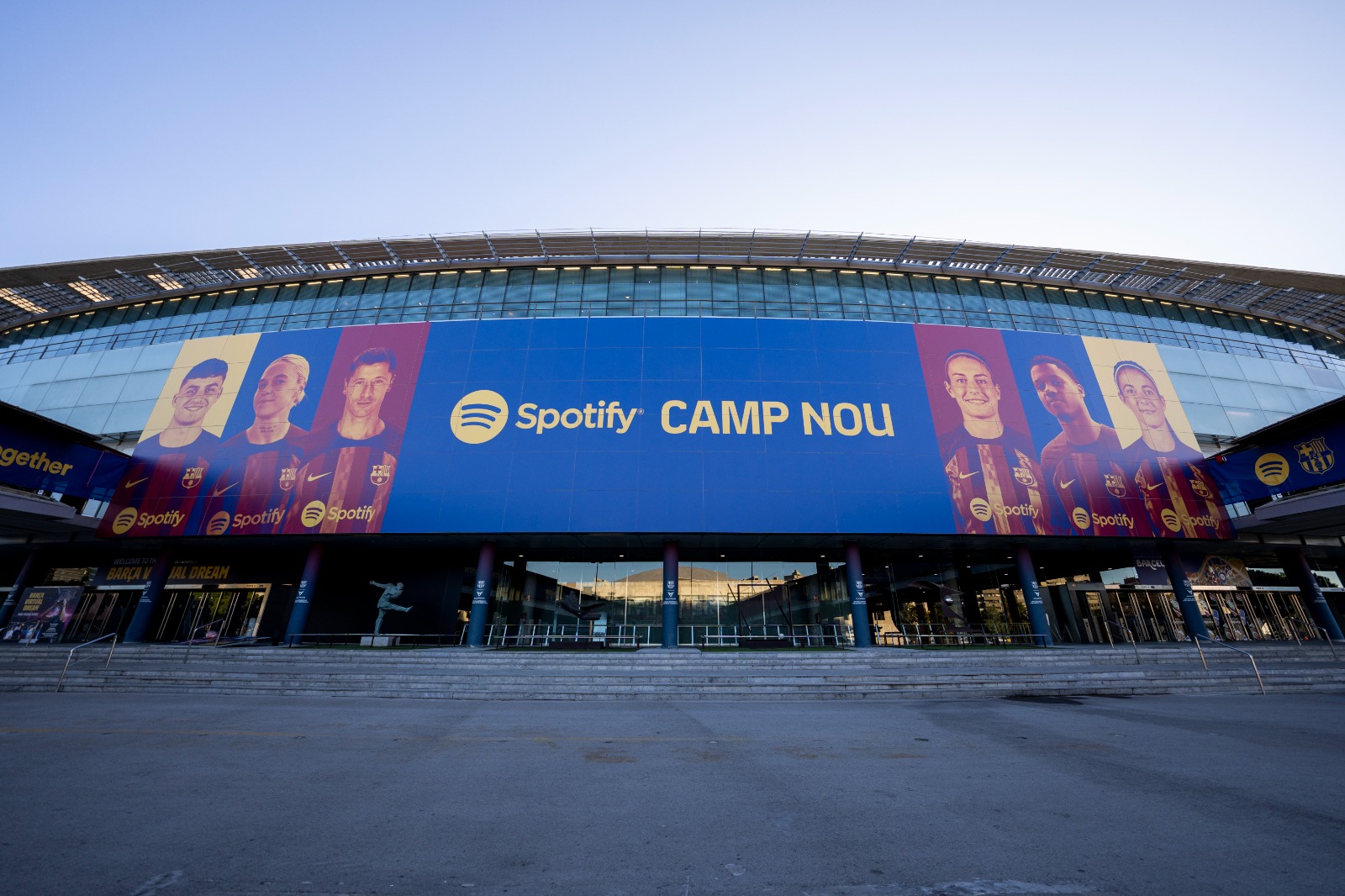
The most symbolically significant commercial decision of the Laporta era, and arguably in the club's post-2006 history, was the 2022 naming rights deal with the music streaming service Spotify.
For the first time in its history, FC Barcelona sold the naming rights to its stadium, an institution that had been known universally as the Camp Nou since its inauguration in September 1957. The ground was renamed the Spotify Camp Nou, with the original 2022 package, covering shirt sponsorship and stadium naming together, worth approximately €280 million. A 2025 extension pushed the naming rights specifically through to 2034, taking the deal's combined value to roughly €460 million.
The vote among the club's delegate assembly was emphatic: 89% ratified the deal, a figure that reveals the extent to which the socios had pragmatically accepted commercial necessity as the precondition for institutional survival.
Espai Barça: The Stadium as Financial Instrument
The Spotify naming rights deal is the cornerstone of a far larger infrastructure project known as Espai Barça, a €1.45 billion comprehensive renovation of the stadium and its surrounding district. The project, which has seen the club temporarily play home matches at the Lluís Companys Olympic Stadium during construction, is designed to fundamentally transform the club's revenue structure.
The financing was secured through a complex arrangement involving unsecured loans and securitised bonds from 20 different investors, including investment banks Goldman Sachs and JP Morgan. As reported by Bloomberg, the repayment structure extends to 2050, meaning that club presidents who have not yet been elected will still be managing obligations created by the current administration.
Projected Annual Revenue Uplift (Post-Renovation, 2027):
| Revenue Stream |
Projected Annual Income |
| VIP Seating & Premium Hospitality |
€120 million |
| New Museum and Visitor Experience |
€80 million |
| Expanded Commercial Areas |
c. €47 million |
| Total Projected Revenue (by 2033) |
€247–346 million |
| Estimated Annual Repayment (Goldman Sachs) |
€94 million |
Source: FC Barcelona, Espai Barça Financial Projections
The business logic is compelling: a 105,000-capacity stadium with world-class VIP facilities, premium hospitality, and year-round visitor attractions could genuinely generate revenue at a scale that makes the debt manageable. The risk is that this logic depends on a sustained period of sporting success, high global demand, and macroeconomic stability, none of which are guaranteed.
The Dubai Deal and the Humanitarian Retreat
In early 2026, the club announced a significant commercial arrangement with Aspin Holdings, a UAE-based real estate developer, for a branded residential complex in Dubai: a "mini-city" featuring towers and community facilities carrying the FC Barcelona brand. As reported by Reuters, the deal generates €12 million annually in licensing fees.
It also includes the placement of a Dubai project-related logo on the back of the first-team shirt for domestic competitions, replacing the UNICEF High Commissioner for Refugees (UNHCR/ACNUR) branding that had occupied that space.
The institutional significance of this transition deserves pause. In 2006, the club made global headlines by paying UNICEF to put a humanitarian logo on its shirt. In 2026, the club is receiving payment to place a luxury real estate logo in the same position. Commentators writing in El País at the time noted that the shift amounted to more than a commercial decision, it was a statement about what the club now considers acceptable, and what it believes its members will tolerate. The arc from the humanitarian partnership to the Dubai property deal is, in miniature, the arc of the club's entire commercial evolution over two decades.
The 2026 Presidential Election: Democratic Mandate for Commercial Pragmatism
On March 15, 2026, FC Barcelona held a presidential election, a democratic exercise that remains genuinely unusual among elite European football clubs. Over 48,000 socios cast ballots, representing 42.34% of the total electorate, at the Camp Nou and satellite polling stations across Catalonia.
| Candidate |
Votes |
Percentage |
| Joan Laporta |
32,934 |
68.18% |
| Víctor Font |
14,385 |
29.78% |
| Blank/Invalid Votes |
984 |
2.04% |
Source: FC Barcelona Electoral Commission (March 2026)
Laporta's 68.18% victory was a decisive endorsement of his financial strategy, his "Defendem el Barça" ("We Defend Barça") candidacy, and, implicitly, the economic levers, the Spotify deal, and the Dubai partnership. Font's campaign had positioned itself as a more cautious, sustainable alternative, but the socios chose continuity over reform.
The election also revealed a critical institutional tension. Under Laporta's watch, the club's debt had grown from approximately €1.3 billion (inherited in 2021) to over €2 billion when Espai Barça loans are included. Supporters argue this debt is "productive", invested in assets that will generate returns. Critics note that the democratic accountability of the socio model only functions if socios have full transparency over what obligations are being created in their name.
The 2024–25 Financial Results: A Cautious Recovery
The club's financial statements for the 2024–25 season offer genuine grounds for measured optimism, alongside reasons for continued scrutiny:
| Financial Indicator |
Value |
Context |
| Ordinary Revenue |
€994 million |
Approaching the €1 billion milestone |
| Ordinary Profit |
€2 million |
Second consecutive year of positive results |
| Debt Reduction |
€90 million |
Down to €469M (excluding Espai Barça obligations) |
| Wage Bill (% of Revenue) |
54% |
Within UEFA Financial Sustainability regulations |
Source: FC Barcelona Audited Financial Statements 2024–25
Most significantly, the club was reported in early 2026 to be within €10 million of achieving compliance with La Liga's 1:1 Financial Fair Play rule, meaning it would soon be able to spend one euro on squad investment for every euro saved or earned, rather than operating under the far more restrictive ratios that had applied since 2021.
This milestone, if achieved, would represent the end of the acute phase of the financial crisis, not the end of the debt, but the end of the emergency.
The Unresolved Question: Can a Democratic Club Survive the Twenty-First Century?
The arc of FC Barcelona's history, from Joan Gamper's foundational advertisement in 1899 to the Goldman Sachs loan agreements of the 2020s, raises a question that no balance sheet can fully answer: can a democratic, community-owned institution sustain the economics of elite twenty-first-century sport?
The evidence is genuinely contradictory. On one hand, the socio model has survived everything the twentieth century threw at it (military dictatorship, civil war, political exile, financial collapse) precisely because its legitimacy is rooted in community ownership rather than the wealth of an individual. On the other hand, the survival of that model now depends on deploying the same financial instruments (asset securitisation, naming rights deals, luxury real estate partnerships) that define the private equity-owned clubs the socios claim to be different from.
Joan Laporta's re-election in 2026 suggests that the majority of socios are willing to accept the current trade-off: commercial transformation as the price of maintaining democratic ownership, rather than ceding control to private capital. Whether this bet proves prescient or catastrophic depends on decisions (sporting, financial, and cultural) that have yet to be made.
A Personal Postscript: Why Any of This Matters
I want to end this series not with a balance sheet, but with a memory, because that is, honestly, where it all began for me.
In April 2009, my footballing world was the Premier League. I had grown up on its pace, its physicality, what some called its "heavy metal" intensity. My particular obsession was Fernando Torres at Liverpool, his clinical finishing, the way he seemed to run through defenders rather than past them. On the night of April 8, 2009, I had just finished watching Torres open the scoring against Chelsea at Anfield with that trademark precision when, almost by accident, I stumbled onto a replay broadcast of something that had been playing simultaneously on the other side of the continent.
It was Barcelona's 4–0 demolition of Bayern Munich in the Champions League quarter-final. The same hour. A completely different universe.
I remember sitting with that contrast for a long time. The Liverpool match I had just watched was magnificent in its own way, urgent, direct, muscular. But what I was seeing now felt like a different language entirely. The tiki-taka rhythm, the suffocating yet beautiful press, and above all, a 21-year-old Lionel Messi who scored twice in a first-half blitz, doing things that seemed to exist outside the normal vocabulary of the sport. It was the first time I genuinely understood what people meant when they called football an art form rather than simply a competition.
That broadcast was, for me, the gateway into everything this series has tried to examine. The Més que un club philosophy. The La Masia method. The democratic structure that had sustained a club through dictatorship and made that extraordinary generation of players possible. I became a student of it, genuinely curious about how an institution like this could exist at all.
Which is precisely why the journey since 2009 has been such a complicated one to watch. The move from the UNICEF jersey to the Qatar Airways jersey. The Neymar collapse and the Bartomeu catastrophe. The Goldman Sachs loans and the Spotify stadium. The Dubai skyline on the back of the shirt where a humanitarian logo used to be.
None of this means the club has become something unworthy of attention or affection. The socio model still stands. Forty-eight thousand members still cast ballots to choose their president. That is genuinely remarkable in world football in 2026.
But what I felt watching that 2009 replay, that sensation of discovering something that seemed to operate by entirely different values from the rest of the commercial sports landscape, is harder to locate now. The club that once paid UNICEF to put a logo on its shirt now licenses its name to luxury towers in the UAE. The club that built a team through an academy and a philosophy now restructures 25-year television rights deals with American private equity firms.
As the renovated Spotify Camp Nou prepares to reopen, the question that Joan Gamper could never have anticipated still defines the institution he founded: can a club that belongs to its people continue to be more than a club, when being competitive requires it to act increasingly like a corporation?
I do not think there is a clean answer. But I think the question itself, the fact that it remains a live and genuinely unresolved tension, is what still makes FC Barcelona the most interesting institution in world football. And that, perhaps, is enough of a reason to keep watching.
This concludes the three-part series on FC Barcelona: democratic institution, cultural symbol, and commercial entity in irresolvable tension.
Ini adalah bagian terakhir dari seri tiga bagian. Bagian 1 mengulas fondasi demokratis FC Barcelona. Bagian 2 menelusuri puncak olahraga dan keruntuhan finansial klub. Bagian penutup ini membahas strategi pemulihan Laporta, era Spotify, dan apakah model socio dapat bertahan di abad ke-21.
Pada musim panas 2021, Joan Laporta kembali ke kursi kepresidenan FC Barcelona dengan mandat yang nyaris paradoks bagi para pendiri klub: menyelamatkan institusi demokratis milik anggota dengan menggunakan instrumen keuangan ala Wall Street.
Klub yang ia warisi dinilai oleh auditor eksternal sebagai entitas yang secara efektif bangkrut. Lebih dari satu miliar euro utang. Tagihan gaji melebihi total pendapatan. Tidak ada kapasitas untuk mendaftarkan pemain baru di bawah aturan Financial Fair Play La Liga. Dan Lionel Messi, lambang dari segala hal yang pernah membuat klub ini begitu melampaui segalanya, tidak mampu memperbarui kontraknya, meninggalkan klub dengan berlinang air mata menuju PSG.
Yang terjadi selanjutnya adalah salah satu restrukturisasi keuangan paling berani dalam sejarah olahraga profesional.
The "Economic Levers": Menjual Masa Depan untuk Mendanai Masa Kini
Administrasi Laporta memperkenalkan strategi yang kemudian dikenal luas sebagai "economic levers" (palanques econòmiques). Logika dasarnya sederhana, meski terasa tidak nyaman: klub memiliki aset jangka panjang bernilai signifikan, dan menjual sebagian aset tersebut dapat menghasilkan likuiditas segera yang diperlukan untuk menstabilkan operasional dan berinvestasi di skuad pemain.
Aset utama yang dijual adalah hak klub atas hak siar televisi kolektif La Liga, aliran pendapatan masa depan yang mencakup 25 tahun ke depan.
| Lever |
Aset |
Pembeli |
Nilai |
Durasi |
| Lever Pertama |
10% hak siar TV La Liga |
Sixth Street Partners |
€267 juta |
25 tahun |
| Lever Kedua |
15% hak siar TV La Liga |
Sixth Street Partners |
Lebih dari €300 juta |
25 tahun |
| Lever Ketiga |
24,5% saham Barça Studios |
Socios.com |
€100 juta |
Kepemilikan saham |
| Lever Keempat |
24,5% saham Barça Studios |
Orpheus Media |
€100 juta |
Kepemilikan saham |
Sumber: Laporan Keuangan Resmi FC Barcelona
Strategi ini memungkinkan klub mencatat pembalikan nasib yang tampak luar biasa dalam laporan keuangan 2021–22, membukukan surplus dan, yang terpenting, memenuhi aturan keuangan La Liga secara cukup untuk mendaftarkan pemain baru, termasuk Robert Lewandowski, Raphinha, Jules Koundé, dan Ousmane Dembélé dengan kontrak baru.
Biaya Jangka Panjang
Namun, trade-off strategis ini sangat signifikan dan perlu diuraikan secara jelas: menjual 25% hak siar televisi selama 25 tahun berarti selama seperempat abad, klub akan menerima pendapatan siaran yang jauh lebih kecil. Keuntungan ekonomi diperoleh di awal; biaya ekonominya terdistribusi selama beberapa dekade.
Para pengkritik, termasuk aktivis socio terkemuka dan ekonom olahraga, berpendapat bahwa lever-lever ini merupakan bentuk "reverse mortgaging", menukar kesehatan finansial jangka panjang demi kelangsungan operasional jangka pendek. Pendukung strategi ini menyatakan sebaliknya: tanpa intervensi ini, alternatifnya adalah akuisisi oleh pihak swasta atau kemerosotan olahraga yang katastrofik dan akan menghancurkan nilai komersial klub secara permanen.
Kedua argumen ini mengandung kebenaran. Lever-lever tersebut bukanlah penyelamatan maupun bencana, melainkan taruhan terkalkulasi pada kemampuan klub untuk menghasilkan pertumbuhan pendapatan yang cukup selama 25 tahun guna lebih dari sekadar mengkompensasi apa yang telah diserahkan.
Spotify Camp Nou: Penamaan Ulang "Kuil" Sepak Bola
Keputusan komersial paling bermakna secara simbolis di era Laporta, dan boleh jadi dalam sejarah pasca-2006 klub ini, adalah kesepakatan hak penamaan tahun 2022 dengan layanan streaming musik Spotify.
Untuk pertama kalinya dalam sejarahnya, FC Barcelona menjual hak penamaan stadionnya, sebuah institusi yang telah dikenal secara universal sebagai Camp Nou sejak inaugurasi pada September 1957. Stadion tersebut berganti nama menjadi Spotify Camp Nou, dengan paket awal tahun 2022, yang mencakup sponsor jersey dan penamaan stadion sekaligus, bernilai sekitar €280 juta. Perpanjangan pada 2025 memperpanjang khusus hak penamaan hingga 2034, membawa nilai gabungan kesepakatan ini menjadi sekitar €460 juta.
Pemungutan suara di antara majelis delegasi klub sangat tegas: 89% meratifikasi kesepakatan tersebut, angka yang mengungkapkan sejauh mana para socio telah secara pragmatis menerima kebutuhan komersial sebagai prasyarat kelangsungan institusi.
Espai Barça: Stadion sebagai Instrumen Finansial
Kesepakatan hak penamaan Spotify merupakan inti dari proyek infrastruktur yang jauh lebih besar, dikenal sebagai Espai Barça, renovasi komprehensif senilai €1,45 miliar atas stadion dan kawasan sekitarnya. Proyek yang memaksa klub untuk sementara menggelar pertandingan kandang di Stadion Olimpiade Lluís Companys selama konstruksi ini dirancang untuk mengubah struktur pendapatan klub secara fundamental.
Pembiayaannya dijamin melalui susunan kompleks yang melibatkan pinjaman tanpa jaminan dan obligasi tersekuritisasi dari 20 investor berbeda, termasuk bank investasi Goldman Sachs dan JP Morgan. Sebagaimana dilaporkan oleh Bloomberg, struktur pembayaran kembali mencakup hingga 2050, artinya presiden klub yang belum terpilih pun masih akan mengelola kewajiban yang diciptakan oleh administrasi saat ini.
Proyeksi Kenaikan Pendapatan Tahunan (Pasca-Renovasi, 2027):
| Aliran Pendapatan |
Proyeksi Pendapatan Tahunan |
| Kursi VIP & Hospitality Premium |
€120 juta |
| Museum Baru dan Pengalaman Pengunjung |
€80 juta |
| Area Komersial yang Diperluas |
sekitar €47 juta |
| Total Proyeksi Pendapatan (pada 2033) |
€247–346 juta |
| Estimasi Pembayaran Tahunan (Goldman Sachs) |
€94 juta |
Sumber: FC Barcelona, Proyeksi Keuangan Espai Barça
Logika bisnis ini meyakinkan: stadion berkapasitas 105.000 kursi dengan fasilitas VIP kelas dunia, hospitality premium, dan atraksi pengunjung sepanjang tahun berpotensi menghasilkan pendapatan dalam skala yang membuat utang tersebut dapat dikelola. Risikonya adalah logika ini bergantung pada periode kesuksesan olahraga yang berkesinambungan, permintaan global yang tinggi, dan stabilitas makroekonomi, yang tidak satu pun darinya dapat dijamin.
Kesepakatan Dubai dan Pelepasan Kemitraan Kemanusiaan
Pada awal 2026, klub mengumumkan kesepakatan komersial signifikan dengan Aspin Holdings, pengembang properti berbasis UAE, untuk sebuah kompleks residensial bermerek di Dubai: sebuah "mini-kota" yang menampilkan menara-menara dan fasilitas komunitas dengan merek FC Barcelona. Sebagaimana dilaporkan oleh Reuters, kesepakatan ini menghasilkan €12 juta per tahun dari biaya lisensi.
Kesepakatan ini juga mencakup penempatan logo proyek Dubai di bagian belakang jersey tim utama untuk kompetisi domestik, menggantikan merek UNICEF High Commissioner for Refugees (UNHCR/ACNUR) yang sebelumnya menempati posisi tersebut.
Signifikansi institusional dari pergantian ini patut direnungkan. Pada 2006, klub membuat headline global dengan cara membayar UNICEF untuk memasang logo kemanusiaan di jerseynya. Pada 2026, klub menerima pembayaran untuk memasang logo properti mewah di posisi yang sama. Komentator yang menulis di El País pada saat itu mencatat bahwa pergeseran ini lebih dari sekadar keputusan komersial, ini adalah pernyataan tentang apa yang kini dianggap dapat diterima oleh klub, dan apa yang diyakini dapat ditoleransi oleh para anggotanya. Busur perjalanan dari kemitraan kemanusiaan ke kesepakatan properti Dubai adalah, dalam skala kecil, busur evolusi komersial klub selama dua dekade.
Pemilu Presiden 2026: Mandat Demokratis untuk Pragmatisme Komersial
Pada 15 Maret 2026, FC Barcelona menggelar pemilihan presiden, sebuah mekanisme demokratis yang tetap sungguh langka di antara klub-klub sepak bola elite Eropa. Lebih dari 48.000 socio memberikan suara mereka, mewakili 42,34% dari total pemilih, di Camp Nou dan tempat pemungutan suara satelit di seluruh Catalonia.
| Kandidat |
Suara |
Persentase |
| Joan Laporta |
32.934 |
68,18% |
| Víctor Font |
14.385 |
29,78% |
| Suara Kosong/Tidak Sah |
984 |
2,04% |
Sumber: Komisi Pemilihan FC Barcelona (Maret 2026)
Kemenangan Laporta sebesar 68,18% merupakan dukungan tegas atas strategi keuangannya, pencalonannya dengan tagline "Defendem el Barça" ("Kami Membela Barça"), dan, secara implisit, economic levers, kesepakatan Spotify, serta kemitraan Dubai. Kampanye Font memposisikan dirinya sebagai alternatif yang lebih hati-hati dan berkelanjutan, namun para socio memilih kesinambungan ketimbang reformasi.
Pemilu ini juga mengungkap ketegangan institusional yang krusial. Di bawah pengawasan Laporta, utang klub telah tumbuh dari sekitar €1,3 miliar (yang diwarisi pada 2021) menjadi lebih dari €2 miliar bila pinjaman Espai Barça dimasukkan. Pendukungnya berargumen bahwa utang ini bersifat "produktif", diinvestasikan dalam aset yang akan menghasilkan imbal hasil. Para kritikus mencatat bahwa akuntabilitas demokratis model socio hanya berfungsi jika para socio memiliki transparansi penuh atas kewajiban apa saja yang sedang diciptakan atas nama mereka.
Hasil Keuangan 2024–25: Pemulihan yang Terukur
Laporan keuangan klub untuk musim 2024–25 memberikan alasan nyata untuk optimisme yang terukur, sekaligus alasan untuk terus waspada:
| Indikator Keuangan |
Nilai |
Konteks |
| Pendapatan Biasa |
€994 juta |
Mendekati tonggak €1 miliar |
| Laba Biasa |
€2 juta |
Tahun kedua berturut-turut dengan hasil positif |
| Pengurangan Utang |
€90 juta |
Turun ke €469 juta (tidak termasuk kewajiban Espai Barça) |
| Tagihan Gaji (% Pendapatan) |
54% |
Sesuai regulasi Financial Sustainability UEFA |
Sumber: Laporan Keuangan Teraudit FC Barcelona 2024–25
Yang paling signifikan, pada awal 2026 klub dilaporkan berada dalam jarak €10 juta dari pencapaian kepatuhan terhadap aturan Financial Fair Play 1:1 La Liga, artinya klub akan segera dapat membelanjakan satu euro untuk investasi skuad untuk setiap satu euro yang dihemat atau diperoleh, alih-alih beroperasi di bawah rasio yang jauh lebih ketat yang telah berlaku sejak 2021.
Tonggak ini, jika tercapai, akan menandai berakhirnya fase akut krisis keuangan, bukan berakhirnya utang, melainkan berakhirnya kondisi darurat.
Pertanyaan yang Belum Terjawab: Bisakah Klub Demokratis Bertahan di Abad Ke-21?
Busur sejarah FC Barcelona, dari iklan perdana Joan Gamper pada 1899 hingga perjanjian pinjaman Goldman Sachs di era 2020-an, memunculkan pertanyaan yang tak dapat dijawab sepenuhnya oleh neraca keuangan mana pun: dapatkah sebuah institusi demokratis milik komunitas mempertahankan ekonomi olahraga elite abad ke-21?
Bukti-buktinya sungguh kontradiktif. Di satu sisi, model socio telah melewati semua yang dilemparkan oleh abad ke-20 (kediktatoran militer, perang saudara, pengasingan politik, keruntuhan finansial) justru karena legitimasinya berakar pada kepemilikan komunitas, bukan kekayaan individu. Di sisi lain, kelangsungan model tersebut kini bergantung pada penggunaan instrumen keuangan yang sama (sekuritisasi aset, kesepakatan hak penamaan, kemitraan properti mewah) yang mendefinisikan klub-klub milik private equity yang diklaim berbeda oleh para socio.
Terpilihnya kembali Joan Laporta pada 2026 menunjukkan bahwa mayoritas socio bersedia menerima trade-off saat ini: transformasi komersial sebagai harga untuk mempertahankan kepemilikan demokratis, ketimbang menyerahkan kendali kepada modal swasta. Apakah taruhan ini terbukti bijaksana atau katastrofik bergantung pada keputusan (dalam bidang olahraga, keuangan, dan budaya) yang belum dibuat.
Penutup Pribadi: Mengapa Ini Semua Penting
Saya ingin mengakhiri seri ini bukan dengan neraca keuangan, melainkan dengan sebuah kenangan, karena dari situlah, sejujurnya, semuanya bermula bagi saya.
Pada April 2009, dunia sepak bola saya adalah Premier League. Saya tumbuh bersama temponya, fisikalitasnya, apa yang sebagian orang sebut intensitas "heavy metal"-nya. Obsesi saya saat itu adalah Fernando Torres di Liverpool, klinisnya finishing-nya, cara ia seperti menembus pemain bertahan alih-alih melewati mereka. Pada malam 8 April 2009, saya baru saja selesai menyaksikan Torres membuka skor melawan Chelsea di Anfield dengan ketepatan khasnya ketika, hampir secara kebetulan, saya tersandung pada siaran ulang sesuatu yang tengah disiarkan bersamaan di seberang benua.
Itu adalah penghancuran Barcelona 4–0 atas Bayern Munich di perempat final Liga Champions. Jam yang sama. Semesta yang sepenuhnya berbeda.
Saya ingat duduk cukup lama merenungi kontras itu. Pertandingan Liverpool yang baru saja saya tonton sangat indah dengan caranya sendiri, penuh urgensi, langsung, penuh tenaga. Namun apa yang kini saya saksikan terasa seperti bahasa yang berbeda sama sekali. Ritme tiki-taka, pressing yang mencekik namun memukau, dan di atas semua itu, seorang Lionel Messi berusia 21 tahun yang mencetak dua gol dalam serangan babak pertama, melakukan hal-hal yang seolah berada di luar kosakata normal olahraga ini. Itulah kali pertama saya benar-benar memahami apa yang dimaksud orang ketika mereka menyebut sepak bola sebagai sebuah seni, bukan sekadar kompetisi.
Siaran itu menjadi, bagi saya, pintu masuk ke semua yang coba diulas oleh seri ini. Filosofi Més que un club. Metode La Masia. Struktur demokratis yang telah menopang sebuah klub melewati kediktatoran dan membuat generasi pemain luar biasa itu menjadi mungkin. Saya menjadi pelajarnya, benar-benar penasaran dengan bagaimana institusi seperti ini bisa ada sama sekali.
Itulah tepatnya mengapa perjalanan sejak 2009 menjadi sesuatu yang begitu rumit untuk disaksikan. Perpindahan dari jersey UNICEF ke jersey Qatar Airways. Keruntuhan Neymar dan malapetaka Bartomeu. Pinjaman Goldman Sachs dan stadion Spotify. Cakrawala Dubai di bagian belakang jersey di tempat logo kemanusiaan dulu berada.
Tidak satu pun dari ini berarti klub telah menjadi sesuatu yang tidak layak untuk diperhatikan atau dicintai. Model socio masih berdiri. Empat puluh delapan ribu anggota masih memberikan suara untuk memilih presidennya. Itu sungguh luar biasa dalam sepak bola dunia di tahun 2026.
Namun apa yang saya rasakan ketika menonton siaran ulang 2009 itu, sensasi menemukan sesuatu yang tampak beroperasi dengan nilai-nilai yang sama sekali berbeda dari lanskap olahraga komersial lainnya, kini semakin sulit untuk ditemukan. Klub yang dulu membayar UNICEF untuk memasang logo di jerseynya kini melisensikan namanya ke menara-menara mewah di UAE. Klub yang membangun tim melalui akademi dan filosofi kini merestrukturisasi perjanjian hak siar televisi 25 tahun dengan perusahaan private equity Amerika.
Ketika Spotify Camp Nou yang telah direnovasi bersiap untuk dibuka kembali, pertanyaan yang tidak pernah terbayangkan oleh Joan Gamper masih mendefinisikan institusi yang ia dirikan: dapatkah sebuah klub yang dimiliki oleh rakyatnya terus menjadi lebih dari sekadar klub, ketika menjadi kompetitif mengharuskannya untuk bertindak semakin menyerupai sebuah korporasi?
Saya tidak berpikir ada jawaban yang bersih. Namun saya rasa pertanyaan itu sendiri, fakta bahwa ia tetap menjadi ketegangan yang hidup dan benar-benar belum terselesaikan, itulah yang masih menjadikan FC Barcelona sebagai institusi paling menarik dalam sepak bola dunia. Dan itu, barangkali, sudah menjadi alasan yang cukup untuk terus menyaksikannya.
Ini menutup seri tiga bagian tentang FC Barcelona: institusi demokratis, simbol budaya, dan entitas komersial yang berada dalam ketegangan yang tak terselesaikan.