There is a quiet paradox at the centre of how we store value. The instrument we trust most for daily life is a piece of paper, or increasingly a database entry, that carries no intrinsic worth at all. The instrument we trust most for permanence is a metal we go to extraordinary lengths to extract and then deliberately refuse to use.
How paper money earns trust
Currency works because everyone agrees it works. A banknote is a claim on nothing in particular, backed by a central bank's reputation and a legal framework that compels its acceptance. That is not a weakness. It is the entire design. Money must move to be useful, and its usefulness comes from circulation rather than substance. You can exchange it for rice, for a house, for an hour of a lawyer's time, for a share of a company. Its value is defined by the breadth of what it can become.
How gold earns trust
Gold behaves in almost the opposite way. It is mined at enormous cost, refined, cast into bars, and then placed in a vault where it does nothing for decades. Only a modest share of annual supply ends up in industrial use; the rest becomes jewellery, investment bars and coins, or sits in central bank vaults as reserves World Gold Council. Gold is trusted precisely because it is inert, scarce, and beyond the reach of any finance ministry that might prefer a different number on the ledger. It cannot be printed into existence by decree, and no committee can dilute it overnight.
So the two assets earn their credibility from opposite qualities. Paper money is believed because it is universally accepted in exchange. Gold is believed because it is universally accepted as unchanged. One is trusted for what it can do. The other is trusted for what it cannot be made to do.
Buffett's case against gold
Warren Buffett has long been associated with a blunt dismissal of gold, built around an anecdote usually dated to a 1998 speech at Harvard: gold, he is said to have argued, gets dug out of the ground somewhere in Africa, melted down, buried again in a new hole, and then guarded by people paid to stand watch over it. An observer from Mars, the line goes, would be left scratching his head. It is worth being honest about the sourcing here: no verified transcript of that 1998 speech has ever surfaced, and researchers who traced the quote found the earliest confirmed citation dates only to 2003, five years later. When a journalist asked Buffett's office directly, his assistant said only that "he has said things like this in the past," which supports the sentiment without confirming the specific occasion Quote Investigator. The joke's exact origin is uncertain. Buffett's aversion to gold is not.
That aversion sits on much firmer documentary ground in his 2011 letter to Berkshire Hathaway shareholders, where he sorted all investments into three categories and placed gold among the assets that produce nothing at all Berkshire Hathaway, 2011 Letter. Such assets are bought not for what they generate but on the expectation that someone later will want them more urgently. A farm produces crops. A business produces earnings. A bond produces interest. Gold produces only the hope of a higher price. In that same letter, Buffett illustrated the point by noting that all the world's gold, melted into a single cube, would be worth roughly the same as buying every acre of American cropland plus several of the world's most profitable oil companies combined, with a trillion dollars left over in cash. One pile, he argued, would keep paying you dividends forever. The other would just sit there.
That is the philosophical divide. Buffett does not dispute that gold preserves purchasing power. He disputes that preservation alone deserves capital when the alternative is ownership of things that compound. His refusal to buy gold is less a market call than a statement about what an asset is for.
Both forms of trust are real. Neither is irrational. But one of them asks you to wait, and the other asks you to work.
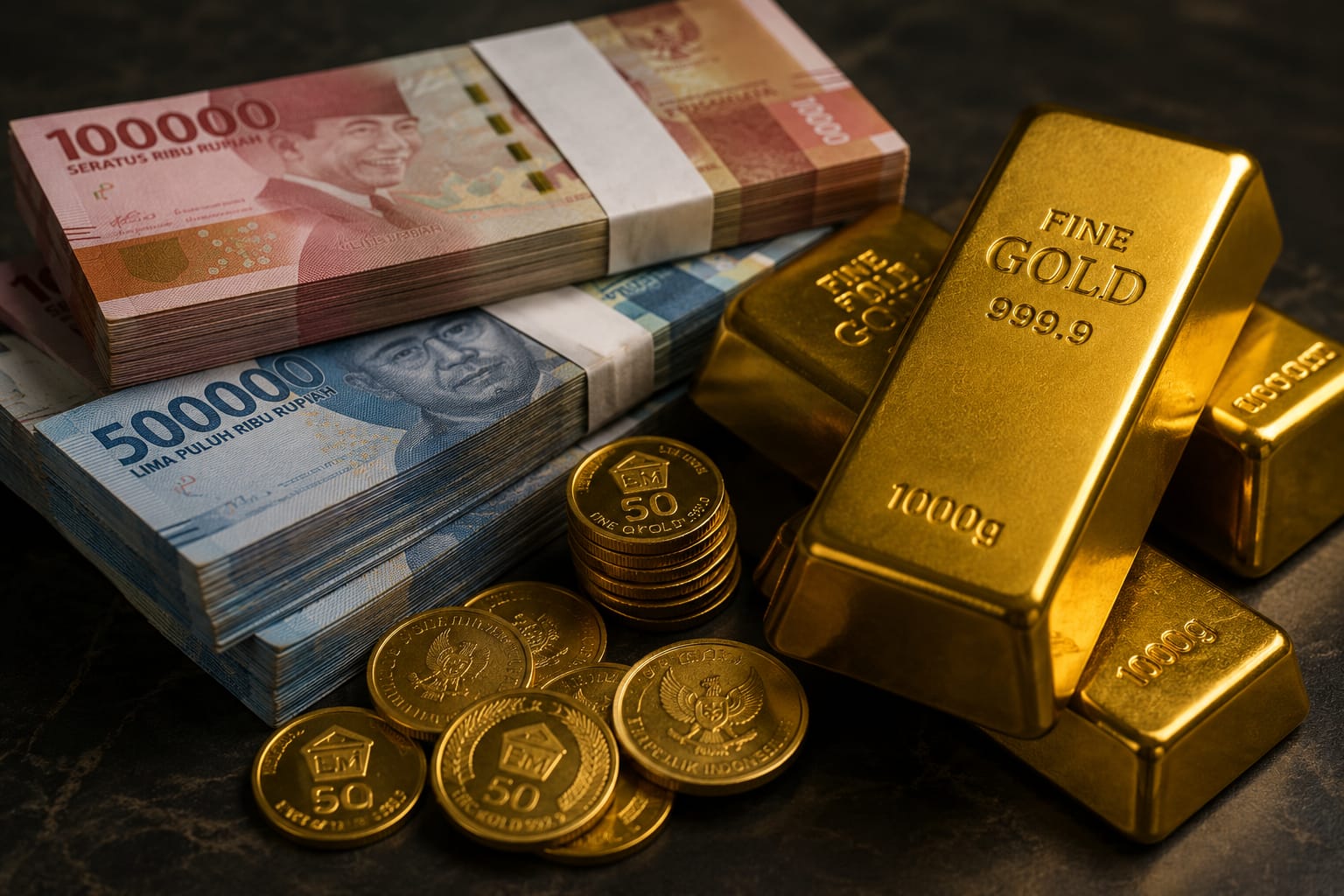
Foto: Uang rupiah dan batangan emas
Ada paradoks yang jarang disadari dalam cara manusia menyimpan nilai. Instrumen yang paling kita percaya untuk kehidupan sehari-hari adalah selembar kertas, atau kini sekadar catatan digital, yang sesungguhnya tidak memiliki nilai intrinsik sama sekali. Sementara instrumen yang paling kita percaya untuk menjaga nilai dalam jangka panjang adalah logam yang kita gali dengan biaya luar biasa besar, lalu dengan sengaja tidak kita gunakan.
Bagaimana uang kertas memperoleh kepercayaan
Mata uang bekerja karena semua orang sepakat bahwa ia bekerja. Selembar uang kertas pada dasarnya adalah klaim atas ketiadaan, disokong oleh reputasi bank sentral dan kerangka hukum yang mewajibkan penerimaannya. Itu bukan kelemahan. Justru itulah rancangannya. Uang harus bergerak agar berguna, dan kegunaannya lahir dari peredaran, bukan dari zatnya. Ia bisa ditukar dengan beras, dengan rumah, dengan satu jam waktu seorang pengacara, dengan saham sebuah perusahaan. Nilainya ditentukan oleh keluasan hal-hal yang bisa ia jelma.
Bagaimana emas memperoleh kepercayaan
Emas berperilaku hampir sebaliknya. Ia ditambang dengan ongkos yang mahal, dimurnikan, dicetak menjadi batangan, lalu diletakkan di dalam brankas dan dibiarkan tidak melakukan apa-apa selama puluhan tahun. Hanya sebagian kecil dari pasokan tahunan yang benar-benar terserap ke penggunaan industri; sisanya menjadi perhiasan, batangan dan koin investasi, atau mengendap sebagai cadangan di brankas bank sentral World Gold Council. Emas dipercaya justru karena ia diam, langka, dan berada di luar jangkauan kementerian keuangan mana pun yang mungkin menginginkan angka berbeda di neracanya. Ia tidak bisa dicetak lewat keputusan, dan tidak ada komite yang sanggup mengencerkannya dalam semalam.
Jadi kedua aset ini memperoleh kredibilitasnya dari sifat yang berlawanan. Uang kertas dipercaya karena diterima secara universal dalam pertukaran. Emas dipercaya karena diterima secara universal sebagai sesuatu yang tidak berubah. Yang satu dipercaya karena apa yang bisa ia lakukan. Yang lain dipercaya karena apa yang tidak bisa dipaksakan kepadanya.
Argumen Buffett menolak emas
Warren Buffett telah lama diasosiasikan dengan penolakan tegas terhadap emas, dibangun dari sebuah anekdot yang biasanya ditautkan ke pidatonya di Harvard pada 1998: emas, katanya, digali dari tanah entah di mana di Afrika, dilebur, dikubur lagi di lubang baru, lalu dijaga oleh orang-orang yang dibayar untuk berdiri mengawasinya. Seorang pengamat dari Mars, begitu candaannya, hanya akan menggaruk-garuk kepala. Penting untuk jujur soal sumbernya di sini: tidak ada transkrip terverifikasi dari pidato 1998 itu yang pernah ditemukan, dan para peneliti yang menelusuri kutipan ini menemukan bahwa sitasi tertulis paling awal baru muncul pada 2003, lima tahun setelahnya. Ketika seorang jurnalis bertanya langsung ke kantor Buffett, asistennya hanya menjawab bahwa "beliau pernah mengatakan hal semacam ini di masa lalu," yang mendukung kesan umumnya tanpa memastikan momen persisnya Quote Investigator. Asal-usul lelucon ini memang tidak pasti. Keengganannya terhadap emas, tidak.
Keengganan itu berpijak pada dasar dokumenter yang jauh lebih kokoh dalam suratnya kepada pemegang saham Berkshire Hathaway tahun 2011, tempat ia membagi seluruh investasi ke dalam tiga kategori dan menempatkan emas di antara aset yang tidak menghasilkan apa pun sama sekali Berkshire Hathaway, Surat 2011. Aset semacam itu dibeli bukan karena apa yang ia produksi, melainkan karena harapan bahwa suatu hari nanti ada orang lain yang menginginkannya lebih kuat. Sebidang sawah menghasilkan panen. Sebuah bisnis menghasilkan laba. Obligasi menghasilkan bunga. Emas hanya menghasilkan harapan akan harga yang lebih tinggi. Dalam surat yang sama, Buffett menjelaskan poin ini dengan mencatat bahwa seluruh emas di dunia, jika dilebur menjadi satu kubus raksasa, nilainya kira-kira setara dengan membeli seluruh lahan pertanian Amerika ditambah beberapa perusahaan minyak paling menguntungkan di dunia sekaligus, dengan sisa uang tunai satu triliun dolar. Satu tumpukan, katanya, akan terus membayar dividen selamanya. Yang satu lagi hanya akan diam di tempat.
Di situlah letak perbedaan filosofisnya. Buffett tidak menyangkal bahwa emas menjaga daya beli. Yang ia sangkal adalah bahwa sekadar menjaga sudah layak mendapat alokasi modal, ketika di hadapannya tersedia kepemilikan atas sesuatu yang bisa compounding. Penolakannya membeli emas bukan sebuah panggilan pasar, melainkan pernyataan tentang untuk apa sebenarnya sebuah aset ada.
Kedua bentuk kepercayaan itu sama-sama nyata. Tidak ada yang irasional. Hanya saja yang satu meminta Anda menunggu, dan yang lain meminta Anda bekerja.